ANZ
ANZ Brazil
 America Latina
 France
 Germany
 Italy
Italy Portugal
 Nordics
 North America
 South Africa
 United Kingdom
Having replaced all plastics with fibre-based alternatives in its packaging, we look at Apple’s latest environmental report.
How Apple Is Replacing Plastic With Paper
How Apple Is Replacing Plastic With Paper
Submitted by: Sam Upton October 6, 2026
As Apple fans all over the world welcome the new iPhone 18 Pro and Pro Max, it’s fair to say not many will be giving much thought to its packaging. With features including the iconic phone’s most advanced camera ever and “huge leaps in battery life and performance”, not to mention the £1,199 price tag for the cheaper Pro model, those that have ordered early will be eager to get their hands on the hardware rather than spend much time considering the environmental impact of its packaging.
But over the past 10 years, Apple have quietly been redesigning its packaging to increase its sustainability, replacing thousands of tonnes of plastic with paper-based materials, increasing the amount of recycled materials and lowering its weight to reduce the burden on the recycling system.
“This year, we made exciting progress toward our Apple 2030 goals by focusing on the areas where we can have the greatest impact: reducing emissions, advancing clean electricity and increasing the use of recycled and renewable materials in our products and packaging,” wrote Sarah Chandler, Vice President, Environment and Supply Chain Innovation, in the company’s 2026 Environmental Progress Report.
Packaging Progress
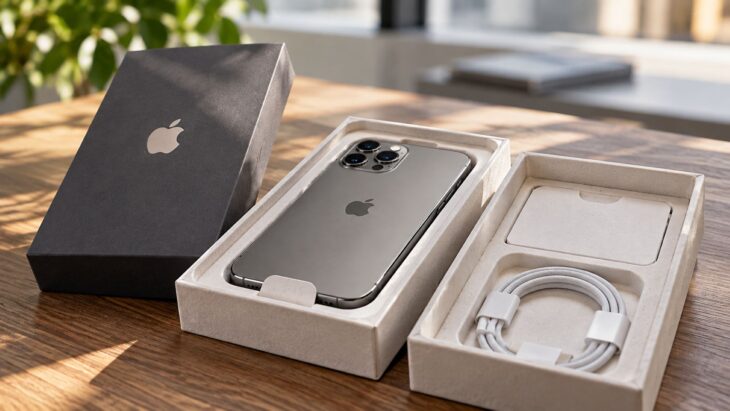
The Apple 2026 Environmental Progress Report is an exhaustive 113-page document that goes through every detail of the company’s sustainability, from carbon footprint and greenhouse gas emissions to energy and water use. But its section on packaging is arguably the most interesting, with the claim that it’s successfully removed all plastics from its packaging in favour of fibre-based alternatives, avoiding the use of more than 15,000 metric tons of plastic – approximately 500 million plastic water bottles.
Having spent the last decade refining its packaging to increase the amount of paper-based materials, from introducing moulded fibre trays for its iPhone 7, iPad and MacBook products between 2016 and 2018 to replacing the plastic screen film for a paper version for the iPhone 12 in 2020, Apple has worked consistently to reduce its impact on the environment.
Alongside all paper-based components being sourced from responsibly managed forests or recycled materials, other packaging initiatives include structural redesigns to streamline recyclability, such as making larger boxes more collapsible to fit into home recycling bins and reducing the amount of material used in the packaging to cut down on material consumption, increase shipment density and reduce transport emissions.
“Across every part of our business, we’re showing how innovation and collaboration can turn big ideas and bold ambitions into measurable progress,” states Chief Operating Officer Sabih Khan. “From expanding recycled material to removing plastic from our packaging, we’re setting new benchmarks that inspire us to reach further and work even harder for the good of people and planet.”
Plastic-Free Path
Of course, you could argue that buying second hand or keeping your existing product for a few years more would remove the entire environmental impact of swapping it for the latest model, but as one of the biggest technology companies in the world, Apple is providing an effective pathway for other companies to follow.
“At Apple, we believe deeply in leaving the world better than we found it, and that commitment runs across everything we do,” says Apple CEO Tim Cook. “These milestones in our work to protect the planet show that ambitious goals can also be powerful engines of innovation. And as always, we’ll keep pushing to build on this progress even more.”
To read the Apple 2026 Environmental Progress Report, go to bit.ly/Apple-Environmental-Report


Share this story