ANZ
 Brazil
 America Latina
 France
 Germany
 Italy
 Portugal
 Nordics
 North America
 South Africa
 United Kingdom

BPIF Printing Outlook Q1 2026
BPIF Printing Outlook Q1 2026
Submitted by: The Two Sides Team February 13, 2026
2025 finished with the strongest output and order performance for four years – according to the latest BPIF Printing Outlook survey. The 2025 Q4 results show that whilst the last quarter didn’t quite match the optimistic expectations, the year still ended with healthy activity levels. Although 2026 has started positively, confidence in the general state of the trade has taken a knock amidst concerns about the UK’s economic climate and looming cost increases. Fortunately, many companies are optimistic about their own performance and have positive investment plans for the year ahead.
Exactly half (50%) of printers were able to increase their output levels in the fourth quarter of 2025. Over one-third (35%) were able to hold output steady, whilst the remaining 12% experienced a decline in their output levels. The resulting balance (the difference between the ups and the downs) was therefore +35, a little down on Q3’s outturn (+39), but a bit further below the Q4 forecast (+45). However, following last quarter, this is the second highest reported output balance since Q4 2021.
The industry did slowly and steadily improve in 2024, following a tough 2023. The first half of 2025 was challenging as heightened uncertainties and cost pressures have been obstacles to growth. The performance in Q1 was disappointing, the Q2 turnaround was welcomed, and the Q3 boost was extremely encouraging, whilst the Q4 forecast wasn’t quite realised it is still a strong finish to the year, especially so by recent comparisons.
The forecast for output in Q1 remains positive, just not as strongly so as in Q3 and Q4 last year.
Volume Of Output – Strong Q4 Just Below Forecast
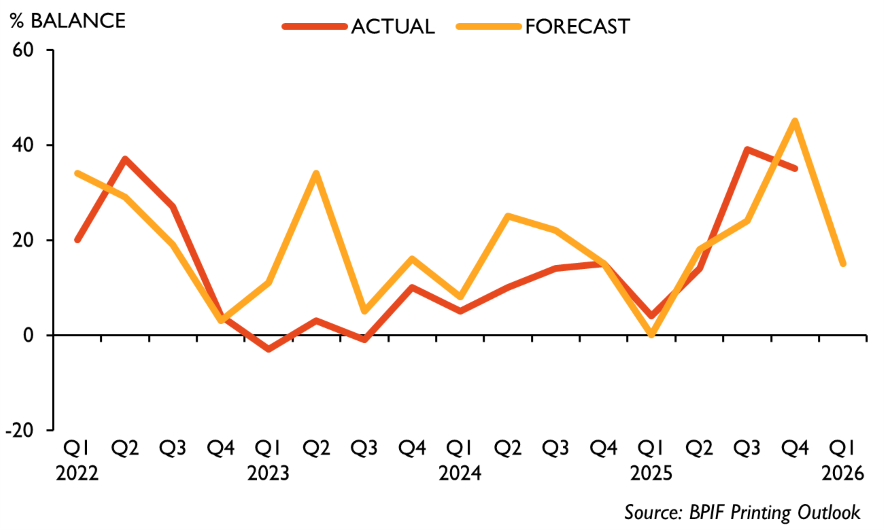
The Q4 output balance of +35 was below the forecast (+45). A balance of +15 is forecast for Q1.
Companies have mentioned concerns over the level of global economic and political uncertainty that forms the backdrop to the environment businesses operate in – but it is more local cost pressures and a rising burden on businesses that is affecting confidence.
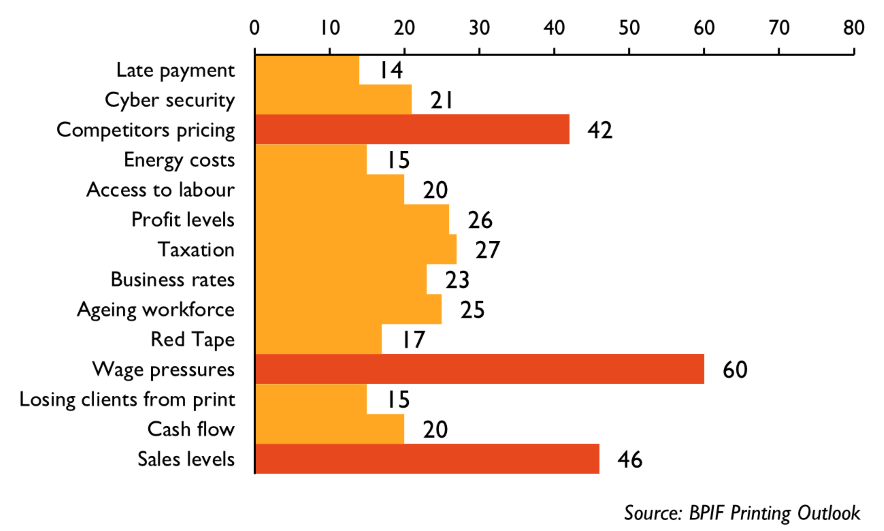
Concerns over wage pressures have forced their way back to the top of list of printers’ top business concerns, pushing ahead of sales concerns and the belief that competitors are pricing below cost. Wage pressure has been selected by 60% of respondents as one of their top five business concerns, up from 46% in October. This was predicted; many companies will be conducting pay reviews in the first two quarters of the year in advance of the next round of minimum wage increases. It is of course not so much the direct impact of the minimum wage levels that impacts companies, but of course the knock-on impact of maintaining wage differentials.
Top Business Concerns – % Of Respondents Selecting
Improving productivity and mitigating costs are a key focus for investments this year – companies have expressed excitement over harnessing AI to increase automation and trigger efficiencies, showcasing a creative industry, and helping a younger generation engage with print. Plant and machinery investment plans are spread across production area bit it is a workflow and automation focus that is underpinning most choices. Specifically, the use of robotics on the production floor is an area that many companies are now actively exploring.
Companies were asked to select their top three specific investment targets for the next 12 months. A few areas stand out – workflow and automation came through as the most popular specific investment target. Digital printing follows next, ahead of management information systems – the same top three as last year, just in a slightly different order.
Top Investment Targets – % Of Respondents Selecting

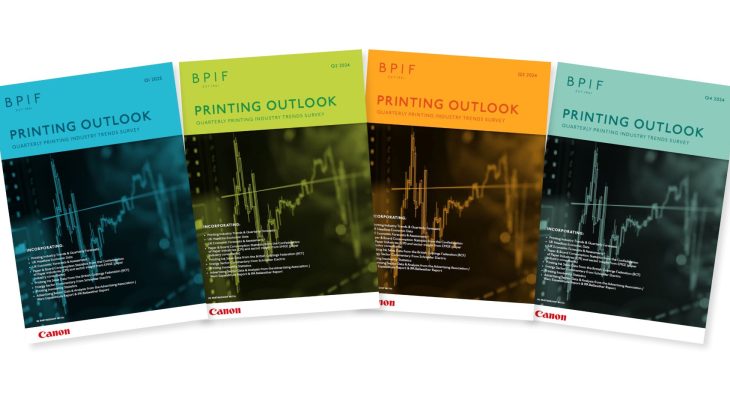
The BPIF Printing Outlook Q1 2026 report features sections on industry turnover, investment, business concerns, costs, pay reviews, access to finance and much more.
Kyle Jardine, BPIF Economist, said:
“Orders and output didn’t quite match the optimistic forecasts for Q4, but the performance results were still very positive, and the outlook for Q1 is relatively upbeat compared to recent Q1 performances.
However, when it comes to the general state of the trade, the negative confidence outlook for Q1 is a concern. Printing and printed packaging companies have considerable pressures on them in the form of wage pressures, demand, competition, and other cost and administrative burdens – but many companies are still upbeat about their own performance potential and have made strong investment plans for the year ahead.”
Charles Jarrold, BPIF Chief Executive, said:
“It was encouraging to see an uplift in expectations and, to a slightly lesser degree, business activity levels at the end of 2025, and we all hope that will continue into this year. The expected concerns are showing through however – we know businesses are concerned about additional costs and red tape, notably on employment costs, which stand out strikingly as the top concern in this survey.
On a more positive note, the Printing Outlook survey provides evidence that there has been a reduction in the cost of finance, an improvement in the availability of finance, a slight extension to credit lines and a deceleration in levels of late payment and bad debt. However, it also highlights that companies are being shifted on to longer payment terms – over 120 days for 8% or respondents. We have highlighted this issue to Government.
New features in the latest survey show the growing importance AI and robotics is having in the industry, but also some critical concerns around cyber security. Areas we will continue to monitor and do what we can to support the industry in improving what is already a beacon in manufacturing productivity and efficiency.”
Duncan Smith, Country Director, Production, Canon UK & Ireland, and sponsor of the printed Printing Outlook report, said:
“As we move into 2026, the print industry continues to evolve, and the focus remains on supporting organisations as they navigate new challenges and opportunities. By pairing technological progress with practical value, the goal is to help print businesses remain competitive, creative, and resilient.
“The BPIF quarterly Printing Outlook report continues to be a key reference point for the sector. Its evidence-based assessment of business confidence, cost pressures, and investment trends offers a clear picture of the conditions shaping day to day decision making. This insight helps guide the development of solutions that reflect the real operational needs of print organisations.”
Summary of key findings:
- 2025 finished with the strongest output and order performance for four years – according to the latest BPIF Printing Outlook survey. The 2025 Q4 results show that whilst the last quarter didn’t quite match the optimistic expectations, the year still ended with healthy activity levels.
- Exactly half (50%) of printers were able to increase their output levels in the fourth quarter of 2025. The forecast for output in Q1 remains positive, just not as strongly so as in Q3 and Q4.
- Industry confidence remained positive in Q4, following the striking uplift in Q3, but it turned out to be less positive than Q3, and below the Q4 forecast. Unfortunately, the current outlook for Q1 dives back into negative territory.
- Many respondents are often more positive when examining the performance and outlook for their own company. Over two-fifths (44%) of respondents reported that their businesses are ‘expanding’.
- Concerns over wage pressures have forced their way back to the top of list of printers’ top business concerns, pushing ahead of sales concerns and the belief that competitors are pricing below cost.
- As in recent quarters, a majority of respondents have been able to keep most cost areas stable in Q4. Although a majority did maintain stable labour costs there remains more pressure coming through than for any other cost area.
- Just over two-thirds (67%) of printing companies have been able to hold margins steady in Q4, the balance moved into positive territory (just) for the first time in four years.
- Increasing profitability through capital expenditure has now become the top priority when it comes to company plans to increase profitability in the next twelve months.
- Less than one-quarter (24%) of respondents reported that they had conducted a pay review in Q4. The resulting average (mean) change in basic pay was 4.0%.
- Export orders exceeded 5% of turnover for 16% of respondents in January, up from 13% in October. Export orders performed significantly better, on balance, in Q4 than they had in Q3.
- General investment intentions appear stronger than they have been for several years. Slight improvements in the availability and cost of finance will be helping to support investment decisions, as will the desire to harness technology improvements as a means to improve efficiency and enhance automation.
- Over one-third (36%) of respondents have now reported that they are already using AI, up from 23% last year. Almost one-third (31%) of respondents reported that they are already using robots within their organisations.
- More than one-fifth (21%) of respondents reported that they have been the target of a cyber attack in the last 12 months.
- The most noticeable recent changes around access to finance and credit conditions have been a reduction in the cost of finance, an improvement in the availability of finance, a slight extension to credit lines and a deceleration in levels of late payment and bad debt. Unfortunately, the ability to monitor late payments is getting obfuscated by the reality of what now constitutes a ‘late payment’ and the shift of companies on to longer payment terms.
Featured in Printing Outlook this quarter:
- Output and orders – last quarter and forecast for this quarter.
- Business confidence, concerns, and uncertainty levels.
- Turnover – annual and monthly turnover analysis and forecasts.
- Capacity – utilisation and constraints.
- Costs – paper & board, ink, labour, energy, and average cost structure.
- Trend data on employment, prices, costs, margins, profits, cash flow and productivity.
- Profitability benchmarks and plans for improvement.
- Pay Reviews – activity and average % changes.
- International trade – export orders and price trends.
- Investment – key targets, AI and robotics.
- Cyber Security – attacks, response plans, and recommendations.
- Financing and credit conditions – access to finance, late payment, and payment terms.
- Consumables – paper consumption and printing ink data.
- Energy – sector update and comment.
For further information on Printing Outlook go to www.britishprint.com/printingoutlook
Join the community
By signing up for the Two Sides newsletter, you join 70,000 industry professionals getting up-to-date sustainability news from across the print, paper and paper packaging industry.


Share this story