ANZ
 Brazil
 America Latina
 France
 Germany
 Italy
 Portugal
 Nordics
 North America
 South Africa
 United Kingdom

BPIF Printing Outlook Q2 2026
BPIF Printing Outlook Q2 2026
Submitted by: The Two Sides Team May 14, 2026
The conflict in the Middle East is taking much of the blame for an under-par start to 2026 – according to the latest BPIF Printing Outlook survey. The 2026 Q1 results show that the performance of output and orders was dented, and that cost inflation is damaging the outlook for Q2. Frustratingly this comes as the industry was seemingly benefiting from a short period of relative stability. Confidence has long been fickle, but the forecast for Q2 has sunk to a level not seen since the onset of Covid in 2020.
Almost two-fifths (38%) of printers experienced a decrease in their output levels in the first quarter of 2026.Just over one-quarter (26%) were able to hold output steady, whilst the remaining 36% achieved an increase in their output levels. The resulting balance (the difference between the ups and the downs) was therefore -2, a long way below Q4’s outturn (+35), and lower than the Q1 forecast (+15). The negative outcome ends a period of positive output balances that had extended to two and a half years.
Hopes that a slow and steady improvement would continue in 2026 have been dashed following a disappointing Q1, and unfortunately the forecast for output in Q2 is the most negative for five years.
Volume of output – suffered in Q1, deeper downturn to come
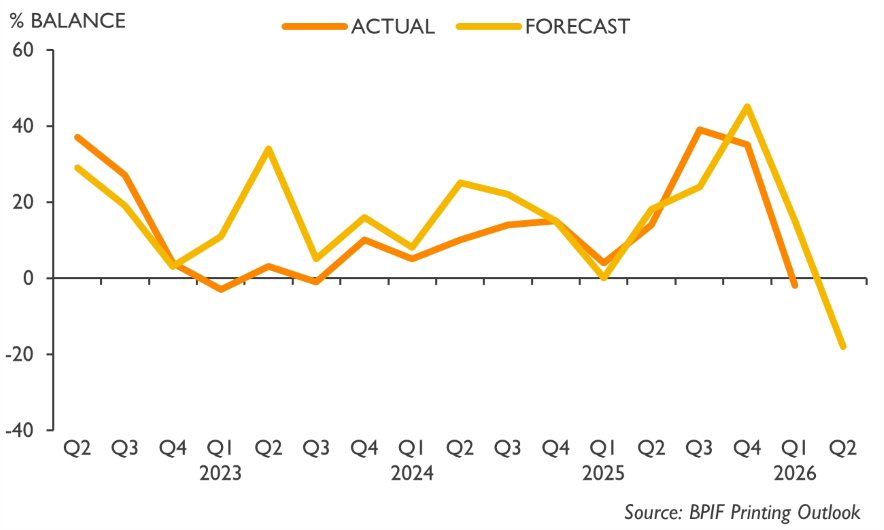
The Q1 output balance of -2 was well below the forecast (+15). A balance of -18 is forecast for Q2.
Industry confidence defied the negative forecast to remain positive in Q1, it has been almost four years since three consecutive positive quarters have been reported, and regrettably the Q2 confidence outlook is the most negative forecast since the onset of Covid. Global conflicts and uncertainties have derailed an admittedly subdued, but improving, economic performance.
Confidence in the general state of trade improved for just one-third (33%) of respondents in Q1, whilst for 38% it remained the same. The remaining 29% reported that the general state of trade had deteriorated in Q1. The resulting balance +4, whilst a downturn from Q4’s balance, remained positive and above the Q1 forecast. Disappointingly, the run of positive industry confidence looks set to expire. Expectations for the general state of trade in the industry in Q2 have reached a level of negativity not seen for six years.
General state of the trade – confidence just positive in Q1 nut Q2 outlook has fallen away
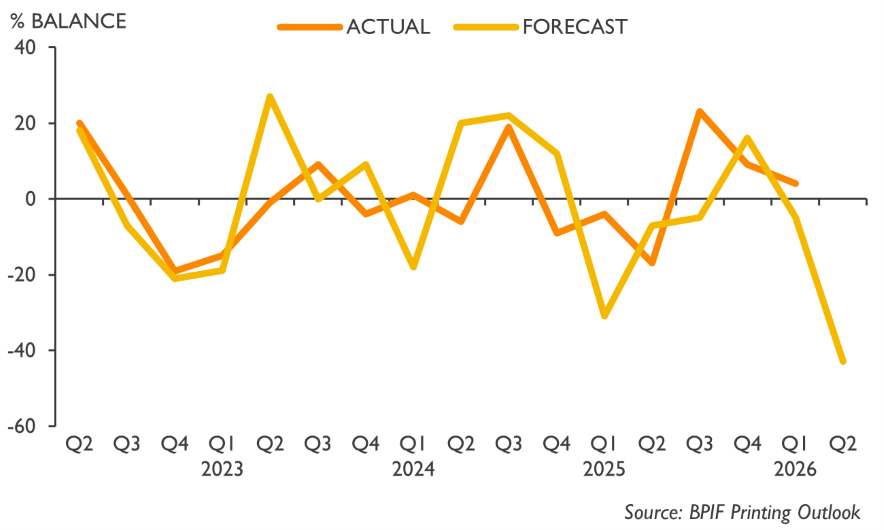
The Q1 balance of +4 is a downturn from Q4, but above the Q2 forecast (-5). A balance of -43 is forecast for Q2.
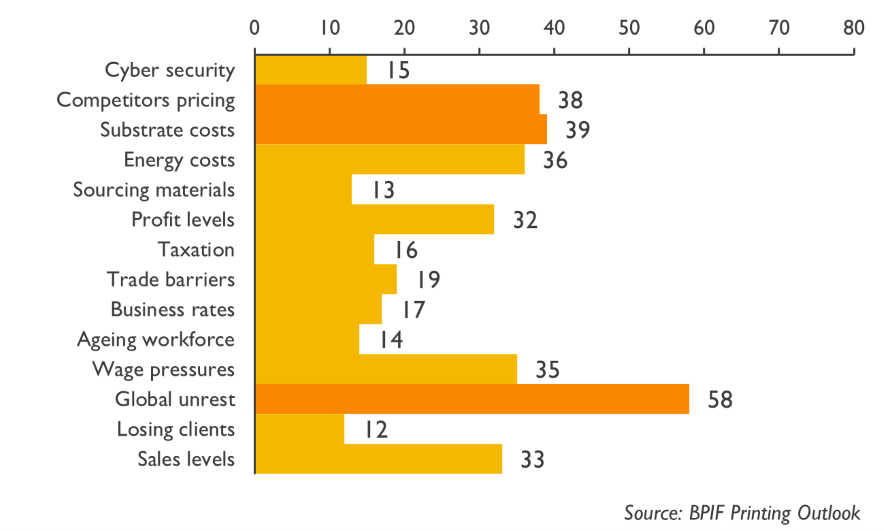
Concerns over the rising level of global unrest have surged from almost nowhere to top of list of printers’ top business concerns, ahead of another sprouting concern – substrate costs. Wage pressures had previously been expected to maintain its position as the top concern, but the war in the Middle East has changed all that.
Global unrest was selected by 58% of respondents as one of their top five business concerns, up from only 12% in January. This was not predicted and is a serious limiter to the progress that the industry has been forecasting to build on in 2026. The knock-on effects will be seen not only in cost pressures but a concern that the uncertainty will delay and dampen orders and activity.
The cost of substrates moved up the ranking to become the second ranked concern in April. Rising pulp and transport costs have quickly fed though to price increases, with more expected to come in Q2. Competitor pricing levels remains the third ranked business concern, with a 38% of respondents selecting it. Energy costs follow behind with a 36% share, up from 15% in January – this is on the basis that increased energy costs will start to seep through once contracts catch up with the inevitable rising cost of oil and gas.
Top business concerns – % of respondents selecting
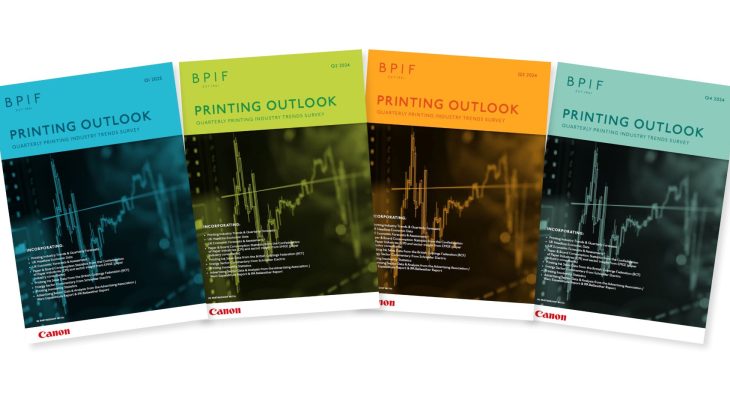
The BPIF Printing Outlook Q2 2026 report features sections on industry turnover, business concerns, costs, pay reviews, sustainability and much more.
Kyle Jardine, BPIF Economist, said:
“It should be noted that not all the industry is suffering to the same degree, the industry is varied and many companies are still very well placed to grow their businesses in 2026. And, if a path out of the conflict in the Middle East can be found, then undoubtedly confidence will markedly improve once more.
“Beyond some level of inevitable price increases, companies are still seeking to keep a very tight rein on costs, and on improving productivity through targeted capital investment. In addition, companies have expressed excitement over niche sector opportunities and developing new products; harnessing AI and other technologies to improve workflow and enhance efficiency improvements – particularly cutting-edge automation and robotics; and leading further environmental improvements.”
Charles Jarrold, BPIF Chief Executive, said:
“Global unrest, rising costs of substrates, other consumables, and energy costs are the significant concerns companies are currently facing. Unsurprisingly, uncertainty has increased at a time when the industry was gearing up for a steady and stable period of improvement in 2026.
“This quarter’s report does appear to be particularly negative, but much of that negativity is rooted in the forecasts and expectations for Q2, which are of course still subject to change as we move through the quarter and international events play out. It must be said though, that it does appear that no immediate resolution in the Gulf is in sight, and even when settled, some challenges will take time to unwind. Our regular contact with Government means we can keep feeding back the state of play in the sector, and they take a keen interest; there are no easy answers, but there are things that the government could be doing to help business, investment and growth, and we will continue to push for action.”
Duncan Smith, Country Director, Production, Canon UK & Ireland, and sponsor of the printed Printing Outlook report, said:
“In a market where conditions remain fluid, access to reliable industry insight is increasingly important. BPIF’s ongoing reporting helps print organisations understand challenges, from demand fluctuations to evolving investment priorities. By providing a snapshot of industry sentiment and performance, the report supports more informed decision making when clarity is essential.
“One area seeing increased scrutiny is the role of materials in supporting sustainability objectives. Paper remains fundamental to print production, and the way it is sourced and manufactured can influence overall carbon impact. As more organisations commit to net zero targets, media selection is becoming part of responsible production planning.”
Summary of key findings:
- The conflict in the Middle East is taking much of the blame for an under-par start to 2026 – according to the latest BPIF Printing Outlook survey. The 2026 Q1 results show that the performance of output and orders was dented, and that cost inflation is damaging the outlook for Q2.
- Almost two-fifths (38%) of printers experienced a decrease in their output levels in the first quarter of 2026. The forecast for output in Q2 is the most negative for over five years.
- Industry confidence defied the negative forecast to remain positive in Q1, and it has been almost four years since three consecutive positive quarters have been reported – unfortunately the Q2 confidence outlook is the most negative forecast since the onset of Covid.
- Concerns over the rising level of global unrest have surged from almost nowhere to top of list of printers’ top business concerns, ahead of another sprouting concern – substrate costs, and the belief that competitors are pricing below cost.
- Industry capacity utilisation was more broadly spread across the capacity ranges in April, compared to January, with more companies operating in excess of 90% capacity, and more operating below 70%.
- The short run of two positive quarters for employment came to an end in Q1, recruitment intentions for Q2 are also now negative.
- Average price levels did remain largely stable in Q1, again staying ahead of a more negative forecast – prices are expected to increase in Q2.
- As in recent quarters, a majority of respondents have been able to keep most cost areas stable in Q1, however the tide has clearly turned, and increases did start to come through in all areas. Although the smallest of majorities maintained stable labour costs there was, once again, more pressure coming through than for any other cost area.
- Increasing profitability through price increases has now become the top priority when it comes to company plans to increase profitability in the next twelve months.
- Just less than one-third (31%) of respondents reported that they had conducted a pay review in Q1. The resulting average (mean) change in basic pay was 3.3%. More than three-fifths (61%) of respondents reported that they will be reviewing pay in Q2. The overall average (mean) expected outcome is a 3.5% increase.
- Whilst a majority of the industry is continuing to make progress towards addressing sustainability issues, a smaller core remains either unable or unwilling to get involved.
- In April 69% of respondents reported that they are measuring their carbon emissions (54% have been doing so for more than 12 months, and a further 15% for less than 12 months).
- The most popular area of attention for sustainability related investments has changed from October – electric vehicles was selected by 72% of respondents, up from 65% in October.
- UK consumption of printing papers and boards in Q4 2025 declined in comparison with Q4 2024 but was stable compared with volumes in Q3 2025.
- Global energy markets have been in tumult since commencement of military action in the Middle East, resulting in a very significant spike in both oil and natural gas markets – also feeding through to electricity.
Featured in Printing Outlook this quarter:
- Output and orders – last quarter and forecast for this quarter.
- Business confidence, concerns, and uncertainty levels.
- Turnover – annual and monthly turnover analysis and forecasts.
- Capacity – utilisation and constraints.
- Costs – paper & board, ink, labour, energy, and average cost structure.
- Trend data on employment, prices, costs, margins, profits, cash flow and productivity.
- Profitability benchmarks and plans for improvement.
- Pay Reviews – activity and average % changes.
- International trade – export orders and price trends.
- Industry insolvency and financial health statistics.
- Sustainability – measuring, reducing, and investing.
- Consumables – paper consumption and printing ink data.
- Energy – sector update and comment.
Join the community
By signing up for the Two Sides newsletter, you join 70,000 industry professionals getting up-to-date sustainability news from across the print, paper and paper packaging industry.


Share this story