ANZ
ANZ Brazil
 America Latina
 France
 Germany
 Italy
Italy Portugal
 Nordics
 North America
 South Africa
 United Kingdom
Find out more about the global trend in purpose-driven packaging, with messages designed to raise awareness of vital issues and tackle misinformation.
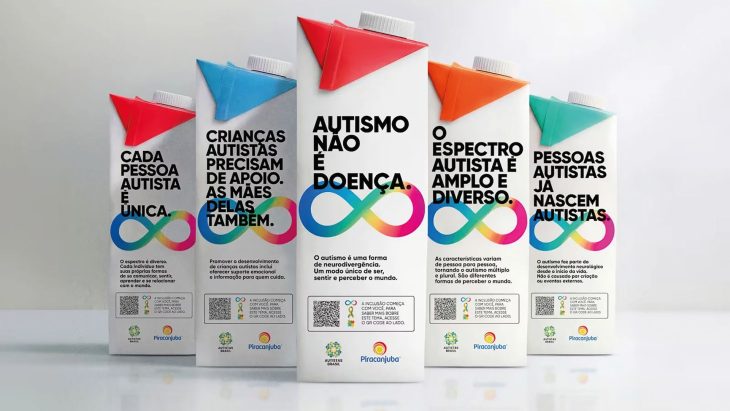
Earlier this year, one of Brazil’s best known dairy brands, Piracanjuba, started to use its cartons to distribute bold messages about autism. Starting from April, around 60 million of the company’s UHT milk cartons each month are being distributed with statements such as “Autism is not a disease”, “Every autistic person is unique” and “Autistic people are born autistic”.
The initiative, developed with autism non-profit organisation Autistas Brasil, was created to counter the vast amount of misinformation about autism in Brazil, which has increased by more than 15,000% since the pandemic. Rather than hoping that people go looking for factual information on the subject, Piracanjuba are placing it in front of their customers, right in the middle of the kitchen table.
“We hope to reach exactly those who the internet doesn’t reach – families who have never had access to a serious conversation about autism,” explains Guilherme de Almeida, President of Autistas Brasil.
“When a carton arrives at the breakfast table of a grandmother in the interior of Maranhão or a working father in northern Minas Gerais, it might be that family’s first genuine contact with correct information on the subject.”
A Trusted Presence
The information campaign by Piracanjuba and Autistas Brasil recognises the power that packaging has and the central role it has in people’s lives. While the majority of brands will use whatever space they have on their packaging to sell the item or run promotions, there are brands that prefer to use that space to tackle misinformation or raise awareness of serious subjects.
Of course, packaging has long had an important role in delivering factual information to consumers, from dosage instructions on pharmaceutical products to allergen details on food and drink packaging. But alongside the legal requirements, brands are increasingly using their trusted status and tactile presence to deliver public service messages, building brand purpose while helping people tackle difficult subjects and improve their health.
One of the most famous examples of packaging that raises medical awareness is Bowel Cancer UK’s GetOnARoll campaign, which calls on retailers and brands across the country to put bowel cancer symptoms on their toilet roll packaging.
The campaign was started in 2022 by Cara Hoofe, an M&S employee who had been diagnosed with the disease, who persuaded the supermarket to print the symptoms of bowel cancer on their own-brand toilet roll.
M&S were quickly followed by Andrex, Aldi, Morrisons, Waitrose, Sainsbury’s, Asda, Co-op, Lidl and, more recently, Amazon. Over four years, the campaign has educated millions of people about bowel cancer and saved thousands of lives.
“When I first put the idea forward to M&S, I was thrilled it was a ‘Yes’,” said Hoofe. “While I hoped that this was the beginning of something bigger, never once did I stop and think that we would be in the position that we are today. This campaign has really shown me the power of collaboration.”
Help When You Need It
As well as physical health, a number of brands are using their packaging to tackle mental health issues, designed not only to encourage people to open up and talk about any problems they may have, but provide information to support and help at times of high stress.
One great example is the partnership between supermarket Aldi and PANDAS Foundation, a UK charity that offers support for families and parents who may be suffering with perinatal mental illness, including prenatal and postnatal depression. Guided by the expertise and knowledge of PANDAS Foundation, Aldi printed information on its Mamia Sensitive and Extra Sensitive baby wipes packaging, such as a list of the common signs of perinatal mental illness plus the details of helplines and support groups.
“This campaign brings together two powerful things: empathy and visibility,” said Annie Belasco, CEO of PANDAS Foundation. “So many parents are struggling in silence, and this puts a message of hope directly into their hands.”
The success of all these campaigns demonstrates the ability of well-designed packaging to place a message directly in front of the people who may need it the most, offering a strong combination of convenience, location and well-researched information to engage with a consumer at exactly the right time.
When used well, this combination can be used to deliver genuine change in someone’s life – and perhaps even save it.